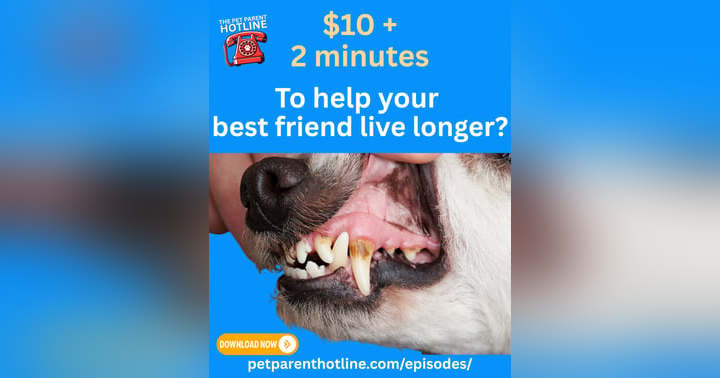
$10 And 2 Minutes To Help Your Pet Live Longer?


What if a $10 purchase used 2 minutes a day could help your pet live better and longer? Most pet parents know they “should” brush their pet's teeth, but fewer than 10% actually do. So, dental disease quietly builds for years and doesn’t stay in the mouth, but instead, silently spreads bacteria throughout your pet's body impacting their organs, their health, and their longevity.
Spending just $10 on a tooth-brush kit and taking 2 minutes a day to brush your pet's teeth, you'll be investing in a better quality, longer life for your pet.
In this episode, board-certified veterinary dentist Dr. Chanda Miles explains why dental health is really about quality of life and longevity, why small dogs and cats tend to get into trouble faster, and what real prevention looks like when life gets busy.
BY THE TIME YOU FINISH LISTENING, YOU’LL DISCOVER:
• Why dental disease is more than a teeth problem, and how it can affect overall health
• Why small dogs and cats are higher risk, and why brushing can feel difficult to do
• What a proper dental cleaning includes, why anesthesia-free cleanings fall short, and when a veterinary dentist may be worth it
CONNECT WITH DR. CHANDA MILES
VETERINARY DENTISTRY SPECIALISTS (KATY, TX) | WEBSITE
OTHER LINKS MENTIONED IN THIS EPISODE:
Veterinary Oral Health Council (VOHC) Accepted Products List | vohc.org
Expert Pet Advice for busy pet parents!
Love the show? Leave a 5-star review so more pet parents can find us, and share this episode with someone who needs it.
Follow:🌍Official Site |📱Facebook |📺YouTube | 🍏 Apple |🎵Spotify
Pet care gets crazy when you're facing behavior issues, rising costs, and confusing pet advice. You need real pet parenting solutions, pet behavior help, and pet budgeting tips you can use every day.
Each week you'll hear pet parenting advice plus expert guidance on dog and cat behavior, dog training, nutrition, stress-free vet visits, and routines that make life easier. We'll help you manage puppy biting, cat aggression, separation anxiety and cat anxiety, emergency vet decisions, and show you how to stay ahead of issues that create stress for pets and their pet parents.
No fluff, no guilt, just practical pet care advice and pet cost hacks to save money, avoid pet parent guilt, and enjoy life with pets.
Follow to stop chasing your tail and start enjoying your pets again.
Contact: Amy@petparenthotline.com
©Ⓟ 2025 Amy Castro
00:00 - Dental Disease Doesn’t Stay In The Mouth
02:17 - “Silent Killer”: Quality Of Life, Organs, Longevity
05:07 - The Chicken Toothpaste Story, And Why Routine Wins
07:23 - Why People Don’t Brush, And How To Make It Stick
11:00 - Small Dogs and Cats: Tiny Mouth, Big Consequences
15:57 - If Brushing Isn’t Happening: What Helps (VOHC)
19:22 - When Cleanings Should Start, What Gingivitis Looks Like
23:28 - Pay Now Or Pay Later: Budgeting, Insurance, Wellness Plans
27:35 - When A Veterinary Dentist Makes Sense
30:11 - Anesthesia Fears, Anesthesia-Free Cleanings, What To Ask Your Vet
34:59 - Antibiotics Aren’t A Dental Plan, And Why It Matters
38:09 - What A Veterinary Dentist Actually Does
Episode Title:
$10 And 2 Minutes To Help Your Pet Live Longer?
Host: Amy Castro
Guest: Dr. Chanda Miles, DVM, DAVDC (Board-Certified Veterinary Dentist & Oral Surgeon)
Summary:
Pet dental disease is not cosmetic, it can quietly affect comfort, energy, and overall health long before a pet stops eating. In this episode, veterinary dentist Dr. Chanda Miles explains why dental disease doesn’t stay in the mouth, why small dogs and cats are at higher risk, what to do if brushing is a struggle, when to consider a professional cleaning, and how to think about anesthesia, cost, and prevention before it turns into a crisis.
Links:
Guest: CONNECT WITH DR. CHANDA MILES
VETERINARY DENTISTRY SPECIALISTS (KATY, TX) | WEBSITE
OTHER LINKS MENTIONED IN THIS EPISODE:
Veterinary Oral Health Council (VOHC) Accepted Products List | vohc.org
Recommended Resources Mentioned:
VOHC (Veterinary Oral Health Council) approved products and dental chews
Affiliate Disclosure:
Some links may be affiliate links, which means I may earn a small commission at no additional cost to you. I only share products and resources I genuinely believe are useful to pet parents.
Veterinary Disclaimer:
This episode is for educational purposes only and is not a substitute for veterinary care or medical advice. Always consult your veterinarian or a qualified veterinary specialist about your pet’s specific needs, symptoms, and treatment options.
Transcript Note:
This transcript has been lightly edited for clarity and readability. Filler words, minor stumbles, and repeated phrases may be removed, while preserving the meaning and tone. Timestamps are included for reference.
Chapters:
00:00 Dental Disease Doesn’t Stay In The Mouth
02:17 “Silent Killer”: Quality Of Life, Organs, Longevity
05:07 The Chicken Toothpaste Story, And Why Routine Wins
07:23 Why People Don’t Brush, And How To Make It Stick
11:00 Small Dogs: Tiny Mouth, Big Consequences
15:57 If Brushing Isn’t Happening: What Helps (VOHC)
19:22 When Cleanings Should Start, What Gingivitis Looks Like
23:28 Pay Now Or Pay Later: Budgeting, Insurance, Wellness Plans
27:35 When A Veterinary Dentist Makes Sense
30:11 Anesthesia Fears, Anesthesia-Free Cleanings, What To Ask Your Vet
34:59 Antibiotics Aren’t A Dental Plan, And Why It Matters
38:09 What A Veterinary Dentist Actually Does
TRANSCRIPT (Named + Timestamped)
Amy Castro (00:00)
If you think pet dental health is just about bad breath, this episode will change how you see it. Dental disease does not just stay in your pet's mouth, and it's one of the most overlooked threats to long-term comfort and health, especially for small dogs and cats.
You've reached the Pet Parent Hotline, your lifeline to practical solutions for your toughest pet parenting challenges. I'm your host Amy Castro, and I'm here to help you cut through the noise and turn expert advice into step-by-step strategies so you can stop chasing your tail and start enjoying life with pets again.
If you think dental health is just about your dog's bad breath or your cat's ugly teeth, this episode is gonna change how you see it. Because dental disease does not just stay in your pet's mouth. It quietly affects their comfort, their energy, and overall health long before most pet parents realize there's a problem.
Today I'm joined by veterinary dentist, Dr. Chanda Miles, and we're talking about pet dental health in a way that actually matches real life. And we're definitely not pretending everybody's pet is getting their teeth brushed every day. And I'm gonna admit right up front, I don't brush my pet's teeth the way that I should. And I also know that fewer than 10 % of you do either. So instead of another lecture, this conversation focuses on why dental disease is so easy to miss, how it affects the rest of the body.
and why brushing really is the gold standard, even when it's a pain in the butt, and how you can think about prevention realistically so that dental care doesn't turn into a crisis and a giant bill later on in life. Dr. Miles is a board-certified veterinary dentist and oral surgeon with veterinary dentistry specialists in Katy, Texas. She's one of only a few hundred veterinary dentists in the whole world, and she brings a practical, clear-headed perspective that every pet parent needs to hear.
So Dr. Miles, welcome to the show. You know, I didn't even know that there were people that specialized in veterinary dentistry. Yeah.
Dr. Chanda Miles (02:02)
Thanks for having me.
⁓ there's only a few of us. So I'd say there's probably only about 250 of us in the world. So we're kind of, we're kind of like unicorns.
Amy Castro (02:17)
So I will be the first one to admit to you that I don't brush my pet's teeth. I feel really guilty saying that. ⁓ And I've paid the piper for it in a couple of different ways. But I kind of thought that maybe we would start this episode rather than just telling people to do something that we've been telling them to do for 30 years, is to look at the bigger picture. Because I think when people think about
brushing their pets teeth or dental health care that it's just about their breath or just about something cosmetic and it's not really a big deal. But what kind of impact does poor dental health have on our pets?
Dr. Chanda Miles (02:52)
Yeah, so you're not the first one to not brush their pet's teeth. That's for sure, right? So it can have a lot of impact. I think really the first biggest thing is quality of life. The reason that you would be brushing your pet's teeth is basically to prevent periodontal disease. Okay, so that's why we brush our teeth. We have fuzzy teeth in the morning, that's plaque. We brush our teeth off and they're nice and smooth. And we go get our teeth cleaned every six months. So we're trying to prevent periodontal disease. And I call periodontal disease the silent killer, okay?
And what ends up happening is these pets get an infection in their mouth. And it's this low-grade infection that can continue to basically what periodontal disease is, is it destroys all the surrounding structures of a tooth, all of the structures that hold the tooth in called the periodontum. And it just is very taxing on the body. So I think that it can become uncomfortable for them.
and they don't have as much energy. They just generally don't feel good, but they still eat, drink, poop, pee and want pets, right? So they still kind of power through all of that. But their quality of life does kind of diminish. And most of the time this happens in older patients. So it's always a thing where the owners think, I thought he was just getting old. I thought he was just slowing down. I think quality of life is the biggest thing, but it has so much impact on kidneys, the heart, liver.
And it can be very taxing on those organs because when pets eat, they get microcracks in their gingiva and that bacteria goes into the bloodstream and you can get bacteria that can lodge in certain places and cause badness or it's just constant, what we call bacteremia. So it's constant bacteria that those filter organs are having to filter. And so when I mentioned the older patients,
organs start to not work. They become insufficient. And so when you have a patient that has kidney disease or even heart disease, getting that constant bacteremia can be very taxing on the body and not help them. Now, it doesn't mean that periodontal disease causes those organs to fail, but it's definitely not helping them.
Amy Castro (05:07)
Yeah, I knew that dental health impacted other aspects of the body, but I didn't really think about it from that standpoint and thinking the fact that if I took care of some of this stuff early on, like my daughter is a fastidious toothbrusher with her little horrible little dog. She's a brat. That's good. She's a brat. She's got her toothpaste. As a matter of fact, one time I went to go brush my teeth and I ended up putting a mouthful of chicken flavored.
Dr. Chanda Miles (05:22)
That's great.
Amy Castro (05:30)
dog toothpaste in my mouth because she keeps that darn dog's toothbrush and toothpaste right there, which I was probably pretty smart. I brush my teeth. ⁓ I got to do Gigi's teeth. Yeah. She's more, had gotten into a good routine, which I think that's probably a good tip for all of us. But exactly what I was going to say is I think if I had known the long-term impact and that I'm impacting my pet's longevity, you know, even if it's not causing those diseases, it's certainly not helping them overcome them or.
through them because the body's fighting multiple things now. Is that fairly accurate? ⁓
Dr. Chanda Miles (06:06)
Absolutely,
100%. Yeah. Yeah, I mean, we know this, a healthy mouth is a healthy body, right? And so you're absolutely right. By maintaining good oral health for your pet, you absolutely can give them longevity and keep them living longer.
and keep them comfortable too. That's the other thing is that just generally oral conditions in general, like not even just periodontal disease, but fractured teeth and any kind of other conditions that are associated with periodontal disease, they can be uncomfortable too. And again, that goes back to the quality of life stuff that I was mentioning. But yeah, you can definitely increase their, I shouldn't say increase their lifespan, but you're not gonna shorten it, that's for sure. By keeping the regimen up. Yeah, an oral healthcare regimen.
Amy Castro (06:52)
Yeah, and I if people knew that, it's a relatively, although we're going to talk about some of the challenges, but relatively simple thing to be doing all along if you get started early and get yourself into a routine. Because we've done a lot of things on end of life with pets and I see the posts where people are like, I wish I'd done this, I wish I'd done that. And this is one of those things you don't have to wish you'd done. So you're not beating yourself, could I have done something else to make my pet's life better? Well, yeah, we could be doing this for sure.
Dr. Chanda Miles (07:21)
exactly. Yeah, exactly.
Amy Castro (07:23)
So I read something the other day that said like 10 % of pet owners, only 10%, brush their pets' teeth. Why do you think it doesn't happen? Because it's not physically hard in some instances, but what do you hear from your pet parents?
Dr. Chanda Miles (07:37)
I hear a lot of things, but I think it doesn't happen because, and I would never say anything bad about general practitioners, but I think what happens is it doesn't get on the list of things you need to start working on when the puppies and kittens come into the office. We focus on so many other things. We focus on vaccines, which are very, very important. I'm not dismissing that. We focus on potty training. We focus on nail trims and ear cleanings. But for some reason, I just don't think
And I'm generalizing, right? That doesn't mean that there aren't vets out there that make it part of their wellness programs, but it's just not necessarily recommended for these wellness programs that veterinarians get puppies and kittens on. So I think that's one thing. And then later, say, like you, they sort of learned their lesson and they go and they have their animals teeth cleaned and then it's recommended, hey, like we've got Fluffy at a clean slate, start doing some home care regimen. And then the other thing is like,
But I can't, they won't let me, they hate it. I don't wanna hurt them, I don't wanna fight with them. And it's the same reason why animals are obese, right? Because we wanna treat them with treats and we wanna spoil them. And so the last thing you wanna do is force something on your pet and you don't wanna ruin that relationship that you guys have.
And so what I try to tell people is the old saying you can teach an old dog new tricks, which you really can. It's getting, like you said, getting in that routine. And so I try to tell clients, think of it of being the same as potty training, right? Everybody is really motivated to potty train their pets.
Amy Castro (09:15)
yeah, and they're usually pretty strict about sticking to a routine. Exactly.
Dr. Chanda Miles (09:20)
Exactly. So I try to say treat it like it's potty training. Your dog is gonna go poop or pee in the house if you don't brush their teeth. Just like a psychological thing. Clearly that's not gonna be the case, but you know to try to get you to do the routine. And I don't say start by brushing your whole dog's mouth. Like we have a whole home care handout that says you got to start slow. And so you may not be brushing your dog's teeth for six months, but you start out slow by
touching their lips, being around their mouth, and then good boy, and you get a treat. And usually treats are what motivates them, but I say if they're not food driven, then pets or whatever it is that they love, and then make it routine. So associate it with something that's positive, positive reinforcement, right? And so if they love to eat, they've got to get their teeth brushed before they eat. If they love bedtime routine, then they've got to get their...
toothbrush with bedtime routine. Probably why your daughter has the toothbrush right next to her toothbrush, right?
Amy Castro (10:17)
And I don't recommend that chicken flavor. It's not so great. God, I can't believe that happened to you. dear. Only me these kind of things happen. Well, the problem is I didn't have my darn glasses on. I was like, she's got toothpaste. And off I go. ⁓ My gosh, very unpleasant.
Dr. Chanda Miles (10:33)
my god.
I'm going to hold on to that story.
Amy Castro (10:36)
That's a good story.
Dr. Chanda Miles (10:39)
So yeah, so just trying to make it routine. And I tell people this, the biggest challenge is getting the humans used to doing it. That's the thing is because now the human is having to get into something new and routine and everybody wants to. It's not that anybody doesn't. It's just getting them used to doing it because everybody does want the best for their pet.
Amy Castro (11:00)
Yeah, and I'm just as bad as anybody. So my little dog, Tinkerbell, she's a four pound Chihuahua, sweetest Chihuahua on the planet, I kid you not. Such a good girl. And didn't brush her teeth, her teeth got bad. She's had the dental cleanings, which are not inexpensive. So not this year, but last year or the year before, she had a pretty heavy duty dental and it was expensive. It was over a thousand dollars. And they had to pull teeth. I said, I'm gonna do it here. I'm gonna do it now.
And did I do it? No, I didn't do it. But this is the game that I play in my lazy mind is that I say, well, her mouth is so tiny and now there's not hardly any teeth left. And am I really getting the toothbrush in there for that tiny little mouth? Well, this year, she had to get all the rest of her teeth pulled out and now she has zero teeth. And that was another, I won't even tell you how much, well, you know how much it is, but the world doesn't need to know how much that was. But it's like.
That was stupid. And so now I gotta be careful what she eats. mean, although theoretically she can eat anything, I, you know, it's like, I did her a disservice by not taking care of that sooner. know.
Dr. Chanda Miles (12:05)
And I have so many clients tell me that because they do have all of these little small breed dogs because they are more prone to periodontal disease. so there are teeny tiny toothbrushes and there's little ones that you can slip on your finger. There's even cat toothbrushes that can go in small little crevices. And again, it's just that working your way up to it and it not being a wrestling match. But.
You know, I mean, obviously we don't want anybody getting bit. That's not, you know, we can't have that. That's why you've got to work your way up to it. But yeah, I have my client sing that song a lot. The same, same thing you're saying.
Amy Castro (12:43)
Yeah, and I feel bad when I see her with her little tongue sticking out and mouth is not... I mean, she is quite old, but still. Poor Tinky-Winky.
Dr. Chanda Miles (12:51)
And what I try to tell clients too about that situation is that teeth are actually very healthy for the bone. And so although they can live just perfectly fine without teeth, but their bone does resorb over time. so they get very thin bone and fractures can happen. like jaw fractures can happen. It doesn't mean that that's super common, but having the teeth in the bone, healthy teeth, obviously, you know, if they're all not healthy, then they got to go. But having healthy teeth,
the micro motions of those teeth and the bone cause reactions for the bone to regrow and the unhealthy bone to get disposed of and then it generates new bone.
Amy Castro (13:32)
Yeah, I hadn't even thought about trying to get something smaller to get in there. I mean, I had seen some wipes and then again, it's pure lazy. I'm just second guessing like, ⁓ those probably don't work. So I just won't do anything like that's not very good logic. Not very good logic on my part. got to out myself because I don't want people feeling guilty, but this is the time to learn and let's move forward and do better when we know better, we'll do better.
You had mentioned before, well, actually I'm going to jump around a little bit because we were talking about little dogs and cats, because I will say everybody in this house, dog-wise, probably has had their teeth brushed. It's just not done like it should be regularly, but not the cats. And so do dogs or cats suffer with periodontal disease more or less? Is it different based on the species? No.
Dr. Chanda Miles (14:20)
But really, they actually both suffer from periodontal disease about the same. Yeah. brushing your cat's teeth is going to be very important as well. That seems a little bit more ridiculous, I think, to a lot of people because cats are not very routine and they're not as amenable to that type of process being done to them. So that's why starting when they're kittens is really good because again, you can train them.
to learn to like it. But yeah, it's a little bit trickier with cats. Cats also have weapons on all four feet that they can use on you if they don't like cats. Probably I would argue to say much sharper teeth than dogs as well. So yeah, they do. They need dental care just as readily as dogs do.
Amy Castro (15:00)
Lots of weapons, yep.
Yeah. And just out of curiosity, why is it that little dogs have more issues with their teeth?
Dr. Chanda Miles (15:17)
⁓ I don't think that we really know, it's definitely a genetic thing. Interesting.
Amy Castro (15:22)
⁓ Because I run a rescue too. And so, you know, when you get dogs that come in, know, the first thing I want to do is look at the teeth and try to gauge how old they are. And so people will look at a little dog's mouth and be like, those teeth are yellow. And I'm like, if they're not built up with tartar, that dog could be six months old because it's it's different with little dogs. ⁓
Dr. Chanda Miles (15:42)
Yeah,
100%. They definitely develop calculus a lot more readily, for sure. And I say calculus, and for some reason in the veterinary world, Tartar is the same thing as calculus, but we call it calculus. I'm using the same word. Tartar, calculus, or interchangeable.
Amy Castro (15:57)
Good to know. I have bought the liquids to put in the water to assuage my guilt. I bought some kind of powder that's supposed to miraculously get rid of the calculus. But what are some things we could be doing if we just are struggling with the whole tooth brushing thing? Are there other little cheats that we can do like that where it's like, okay, at least that does something, you know, a progression towards being better people.
Dr. Chanda Miles (16:23)
Yeah. So I'm obligated to say that the best you can possibly do is get your animals teeth cleaned on a regular basis. And we'll probably get to that point. We're going get there. Yeah. So that's first thing. But if we're going to talk about cheats, there are some things. There's dental chews. They can help reduce plaque. There's dental diets, which I am a firm believer of. your
Amy Castro (16:33)
to that.
Dr. Chanda Miles (16:47)
dog or cat has to not be on a special diet for some other reasons, like kidney disease or heart disease, or there's other, you know, allergies is a big one too. Water additives. I don't know how well they work. I don't strongly recommend them, but if an owner wants to do them, I will support them in that. You have to make it exactly as the instructions say. So sometimes people think a quarter teaspoon is a pour, right?
Amy Castro (17:16)
I've
already failed. just go... in the giant dog bowl for everybody. Okay, so that's going in the garbage.
Dr. Chanda Miles (17:24)
Yeah,
so you have to make it exactly as it says and then you need to make it fresh every day. And the thing is, living in a hot environment, animals go outside and then they come in and they park themselves at the water bowl, right? Because it's hot. And if the animals don't like that water, then they often won't drink. And so then they dehydrate themselves. So then I always say, well, then offer untreated water as well. And if it doesn't bother the animal and they drink the treated water, then fine. Then it can probably have a little bit of benefit.
But the water additive, in my opinion, probably has the least benefit. ⁓ Yeah, I guess there are some powders. I'm not really sure how well they work either. There is, it's pertinent to talk about this too, is that there is a website. It's vohc.org. It stands for Veterinary Oral Health Council.
and this organization is overseen by veterinary dentists. And there's a products page on that website that have the veterinary dentist seal of approval, the VOHC seal. And so those companies have had to go through a much more rigorous process to prove that they deserve the VOHC seal. And so I would strongly recommend that everybody check that website out before making a decision on a certain product.
Because you can put anything on a pet shelf, right? It doesn't mean that other products are not effective that don't have the VOHC seal. I'm not saying that either. But at least we have a website that people can go to as a starting point.
Amy Castro (18:57)
Okay,
that's good to know. So yeah, if it makes you feel better that you're doing some of those other things as well, but it really goes back to the routine. And how often should we be brushing if you're gonna do it right? Is it a daily thing? A daily thing? So keep it up there by your toothbrush and just don't mix up the paste.
Dr. Chanda Miles (19:16)
I say teeth or teeth or teeth, it doesn't matter whose face they're in, they still have that daily care. Yeah.
Amy Castro (19:22)
Okay. So you had mentioned something about regular dental cleanings and you just like we do. you know, that, and what's so crazy about it is I am like a crazy person when it comes to going to the dentist. I would, I would skip other things, you know, anytime, but I go to my dentist every six months. I'm like, I'm like weird about my teeth, but ⁓ yeah. So, so how do I know when I need a cleaning? And because I don't feel like in my experience with regular vets,
I don't remember anybody like recommending dental cleanings until it's well into the pet's life and they're starting to have talculeus buildup and things like that. So, I mean, we should be doing it while they're young too and just getting a cleaning.
Dr. Chanda Miles (20:00)
Mm-hmm.
Yeah, so there's a little bit of leeway on some of these recommendations. So we talked about small dogs versus large dogs, and then young versus old. So small dogs are going to need cleanings sooner in their lives than large dogs. OK, so we got that established. And then my recommendation is that if you start to see that there's calculus buildup, and certainly if you see a line of gingivitis, it's time for a cleaning.
because gingivitis is the first stage of periodontal disease and is the only reversible stage.
Amy Castro (20:41)
Ginger
Vines, just for people who are listening, is the red along the gums, right?
Dr. Chanda Miles (20:49)
Yep,
the red gums. Yeah, exactly. And you'll see, just like you said, it's like a line. It's like this red line that runs. it's right where the tooth meets the gums. That's where the gingivitis is gonna start. Yeah, exactly.
Amy Castro (21:03)
Because
that's already a sign that it's getting irritated by the calculus, right?
Dr. Chanda Miles (21:07)
Exactly. Yeah. So it's time for a cleaning because again, that's the only time you can reverse it. If it hasn't, again, as I mentioned, the silent killer, if it hasn't already started to destroy bone underneath the gum line and cause periodontal pocketing, et cetera. So that's kind of my guideline. And that's for everybody. That's cats, dogs, large, small, all of the above. If you're brushing. So this is the tricky part is that we're obviously saying
you should be brushing your pet's teeth, that's what's best. Well, you're gonna be keeping their teeth fairly clean during that time. So now this basis of when they need a cleaning gets a little bit skewed because they still need to have a cleaning because again, periodontal disease happens under the gum line. So you could keep the teeth fairly clean with preventing calculus from actually adhering to the enamel, but the plaque and bacteria can start destroying
basically the attachment of the tooth to the gums and to the bone under the gum line. you're- Right. So you're not seeing it. And so we don't have this, I mean, you run a rescue, right? So like, we don't have this basis of lifting the lips and either aging or seeing how bad their teeth are. If you have someone that's being compliant, just like we're asking them to be, then it gets a little bit tricky on when to start getting their teeth cleaned. Right. My generic answer is that-
Amy Castro (22:09)
seeing it.
Dr. Chanda Miles (22:33)
I usually start recommending cleanings at anywhere from two years old to three years old. And then that's a baseline, right? And so you get their teeth cleaned and then you have full mouth of x-rays and do the whole full tune up and then you've got a baseline. And then the generic guideline is annually, but that can be flexible. Again, if you have a large breed dog that
They usually don't need cleanings that often. And if they're not developing any kind of gingivitis, I mean, if they have like zero gingivitis, they probably don't have periodontal disease. But that's the problem, right? If they just have gingivitis and don't have heavy calculus, you often don't know how bad it is. So, you know, that's not to confuse anybody, but that's just to kind of have it on your radar that probably like a three-year-old, you should start thinking about it and having it.
Amy Castro (23:14)
Yeah.
Dr. Chanda Miles (23:25)
on the radar to get a professional cleaning.
Amy Castro (23:28)
Yeah. And I know people that are listening to this are thinking, that's like a lot of money over the course of the lifetime of my pet. Is it, is it pay now, pay later kind of thing? Like you can either pay a little bit less now, or you can have the $2,000 dental like I did on the mouth the size of my pinky. But how do we get that message out to people about the money side? Cause they'll buy the expensive toys and the...
raw dog food and I mean everything is expensive nowadays and then for whatever reason it's just easy for people to say including me like let's not do that this year or I'm not going to do that until there's a problem.
Dr. Chanda Miles (24:06)
Mm-hmm. Yeah. No, you're absolutely right. Like, it's ⁓ a little bit now to have a better quality of life versus having a big chunk of money and then having to take a lot of your pet's teeth down the road by not having regular care. No. ⁓ I mean, it's part of wellness.
So again, this kind of goes back to when you bring your cute little puppy to Dr. Smith and you're so excited and you do, you go buy all the expensive toys, you get them training, you do all that stuff. But like a lot of people don't think about what it costs to maintain a pet from a wellness standpoint. So I would say one of the biggest, best things that has helped my clients out is pet insurance now. I was just thinking that.
The caveat to that is that a lot of pet insurance companies don't cover wellness and they consider routine cleanings as wellness. it's a little tricky there. So then I would say to the people that do want to start thinking about cleanings on a regular basis, you just put aside a fund. Because I do tell clients that too, like you put aside a fluffy fund and if you're going to buy five toys, buy two toys and put the rest towards the fund. I'm not here to tell anybody how to do their finances.
Amy Castro (25:22)
But no, we do. We'll tell them because we did a whole episode. We did a whole episode. had a financial planner come on because it's like, you can't tell me that you don't have that money at the end of the year for something you knew was coming all year. You could have made that happen or maybe you could have put a dent in it. I know everybody's situation is different, but yeah, of course you're not going to able to come up with the $2,000 today because you hadn't planned for it. But if you'd have been planning for it over the course of a year, one of the things that I try to stress on the show is just having a conversation with your vet.
just because the standard might be every year, but maybe I could go a year and a half and still maintain my pet's health, just kind of talking to them about your specific pet and being honest about your financial situation. It might be a matter of let's not do this now and let's do this now instead.
Dr. Chanda Miles (26:10)
Yeah, yeah, yeah. mean, you can definitely do that. You just prioritize the health just because you go in and it's standard to do a bunch of tests. And don't get me wrong, tests are very valuable to veterinarians because, again, Fluffy can't talk and animals get all kinds of weird diseases. And so that's how you test for them. yeah, you can have a conversation with your veterinarian to say, OK, well, can I prioritize? Can I?
have vaccines done at this time and what vaccines does my dog need as far as like what its exposure is. then as far as dentistry is concerned, and I do this with my clients all the time, they'll say, well, what's my timeframe here? And I'll say, well, look, my generic answer is one year. But if your veterinarian takes a look in there and says that they're good, then maybe we can go another six months. But I wouldn't go longer than two years.
So at least I kind of give a guideline so that they have an idea of like, well, don't go longer than this. And sometimes I'm like, yeah, you can't, you have to do this. Like your dog is super duper prone. I'm very honest with them about it. ⁓ Yeah. back to what I was gonna say about the wellness programs, there are some corporations that will get people on a wellness program that do include regular cleanings. So that's also something that can help keep them on track.
Amy Castro (27:35)
Yeah, and probably something you should consider, because that's another thing people don't consider is when they get their pet, whatever it might be, a lab mix or is it a Pekingese? so thinking about the different expenses that those might have, the different issues that they might have, that Pekingese is probably going to need more frequent dental care. So that's something to know going into it. So when people come to see you, are they coming after going to their regular veterinarian because there's something
extra special wrong that's going on that they can't handle? Or is it like, just, I'm a better pet parent, so I'm gonna go straight to the dentist. How does that work? I would assume it's a little bit of both.
Dr. Chanda Miles (28:16)
It is, yeah, it is. A majority of the patients I see are from referral though. So my practice is self-referral, so anybody can come see me, they don't have to have a referral. But most of the time people don't know that I exist and it's from the referral from their primary that they figure out that I do exist. And so most of that is because the primary veterinarian is no longer comfortable doing whatever they think is gonna need to be done. So severity of prairie donald's disease,
they think this dog needs possibly full-mouth extractions or 20 plus extractions and they're like, nope, I'm out. Or, I mean, that's one example, but there's other things. I do a variety of things. So oral tumors, jaw fractures, all of those things that's not in the wheelhouse of the primary veterinarian. But if we're talking about just wellness, it's either the severity of the disease and lack
of confidence that they can take care of that, or they just don't have the staff, or it's not in their expertise, or they need an anesthesiologist. So I have a board-certified anesthesiologist at my practice, and I pride myself on that because it actually does allow us to treat patients that otherwise would not get anesthetized because everybody's scared to do it.
Amy Castro (29:35)
So you're doing all the French Bulldogs in Houston.
Dr. Chanda Miles (29:37)
You got it. Yeah. Well, I really what I'm doing is all of the geriatric small breed dogs that have heart disease plus or minus kidney disease. Yeah. Or that have never had a cleaning. And that's a bummer too. You know, they're coming into me and they're 10, 11, 12. I mean, we do, we do very geriatric patients. I mean, we do up to a bit 20 years old, 18, 19, 20 years old. But yeah, that they've never had a cleaning and the primary veterinarians like, yeah.
This is going to be a lot. You need to go see somebody that's equipped to do
Amy Castro (30:11)
So
you were talking about the risk with some patients for sure. What about the fear that people just have kind of generally about their pets? Because I've been seeing things about non-anesthetic cleanings and it's like, come on, could that really be effective? I mean, it's probably doing something, but it's probably not as effective as when you've got a knocked out pet there where you can really get in there and do what you need to do. But I think people are afraid. I never was really afraid of anesthesia.
but it was only because I hadn't been burned by it. And then we had a pet that came through the rescue that I had under anesthesia. I like, I think twice now, so.
Dr. Chanda Miles (30:47)
Mm-hmm. Yeah, I know. It's a big, big issue, and I definitely would never discount it because anesthesia does carry a risk. It actually carries a fairly low risk, especially for young, healthy animals. And it is, unfortunately, a necessary evil for us to have to do to get a good, thorough cleaning. And the anesthesia-free cleanings, ⁓ yeah, that's the thing. It's like...
I want to say that they might have some benefit, but I've seen so many patients get anesthesia-free cleanings and their mouths are a mess. So I think it's just very superficial. Again, you can't get under the gum line. These patients are not getting x-rays. They're not getting thorough oral exams. And so that's why we need anesthesia in order to be thorough. And I think every vet has their own comfort level with anesthesia.
And from everybody that refers to me, sometimes they just have a limit, whether it be an age limit or only routine cleanings or time limits sometimes too. We don't have any limits with us, but yeah, it's a concern for a lot of people and I don't discount it. just, that's another conversation with your primary veterinarian is to say what's your comfort level, what's your staffing like.
who's monitoring, how many people are monitoring. And the other thing too is your arsenal of medications that you have. We have a profound amount of drugs that we can use for all different varieties of patients that have a variety of comorbidities, right? So a heart patient cannot get certain medications, whereas a young healthy patient can get a lot of different medications. And so that's the other thing too is that
primary care veterinarians often don't have that arsenal of drugs. so there are all those variables that it's just a conversation with your vet to say, what's your comfort level anesthetizing my pet that has these health problems and what's your staffing like? Will my dog be monitored by one person, by two people, by a person walking by kind of thing because everybody's got a different situation. Yeah.
Amy Castro (32:58)
yeah.
And it can vary wildly depending upon where you go.
Dr. Chanda Miles (33:03)
Exactly. And I will say that a lot of that is where cost is worth every penny because if the veterinarian is staffing heavily, then that means they're paying two people to monitor your patient. You have one person that's solely in charge of monitoring anesthesia and one person that's solely in charge of doing the dentistry. Rather than having one person doing the dentistry and monitoring anesthesia, because you can get kind of sidetracked on things like that.
So hopefully you know that you're getting what you pay for, to speak, because you do have to pay staff to monitor your pet. And you want them to be experienced in that as well. And so an experienced person is going to be more expensive than a non-experienced person.
Amy Castro (33:52)
Right. Yeah. But I think what people need to realize too is for you, where your practice is solely focused on that, that person's just going to know more. mean, not that my vet doesn't stay up on things, but they're trying to stay up on 50 different body systems and parts and whatever else. And you're focusing on one area. So it's not that you don't have a lot of things to focus on. realize there's a lot going on. But it's your specialty.
Dr. Chanda Miles (34:14)
Yeah, no, but it's my special. Again,
that's not to say that general vets, that they aren't well equipped. They are. You just have to ask them what their comfort level is for your pet's specific needs.
Amy Castro (34:28)
Mm-hmm. That's a good point. You know, you were talking about, or I had brought up that people are afraid of their pets going under anesthesia, and so they put it off. But you had also said that veterinarians are, and rightfully so, because you can put in the paperwork all day long that being under anesthesia comes with risk, and you assume there's going to be risk up to including death. And it's like, but God forbid the pet dies getting its teeth cleaned. so do you see veterinarians doing things to try to avoid the anesthesia?
other types of treatments.
Dr. Chanda Miles (34:59)
Yeah, definitely. ⁓ I see this frequently and I'm not a big proponent of it, but they'll prescribe antibiotics. And although it's not that it's not warranted, but you know, like one course of antibiotics can squelch some of the bacterial load that's in the mouth and you will see an improvement. The animal will feel a little bit better, but it's not getting to the root of the problem, right? You really have to do a cleaning and a cleaning has to be under anesthesia. So.
I think what happens is the veterinarian is worried about anesthetizing the pet and it doesn't come to the forefront of their mind to say, refer to me where we will provide appropriate anesthesia and obviously dental care. And so they do something like pulse antibiotics and pulse antibiotics is doing a course of antibiotics once a month. Yeah, like for a week and then coming off three weeks. And that's not being a very good antibiotic steward.
because what ends up happening is those patients are now getting antibiotic resistance. And we have a huge problem with antibiotic resistance in this country. really bad... Yeah, 100%. And then the other thing too, to think about the people is that those people are around those pets. So they're actually getting exposed to their resistant bugs as well. And then the people can get the resistant bugs. So it's not just...
Amy Castro (36:06)
And people and pets.
Dr. Chanda Miles (36:23)
I mean, it's mostly the animal, because we're around them all the time, you definitely can get exposed to that. So I really try to discourage pulse antibiotic therapy. It's one of the things that when I travel and I speak, it's a little soapbox of mine. try to have a little blurb about it at the end to just say, guys, really truly try to refer to a specialist. Because I think sometimes too, veterinarians think that the client won't go.
And so they don't mention it like, ⁓ they're not going to go to a specialist. But you have no idea. You really have no idea what that person will do for their pet. they have, you know, they don't have to give you the inclination. They'll do anything for their pet, but they might go home and start thinking about it and go, you know, I think I'm going to do it. So that's probably one thing that I do see a lot that veterinarians. ⁓
Amy Castro (37:17)
Yeah, better to just do something than to send it out to the universe and not know if it's going to happen. But that could be something that could be follow-up as well. Just the communication between the pet parent and the veterinarian. I know they've got nothing else to do, but if I make a referral to a specialist, I could certainly at least send a follow-up text to the client to say, did that referral work out? Were you able to get it? Just something to be like, Yeah, absolutely. You should do that.
Dr. Chanda Miles (37:47)
As if that's such a good idea, because I mean, every place has their own system of reminders. And it's just a matter of talking to your staff and saying, send a reminder just to see if they followed up on that.
Amy Castro (37:58)
All right. So you had mentioned there's so few veterinary dentists around, and so we're lucky enough that we have you here in Houston. Can you tell us a little bit more about your practice?
Dr. Chanda Miles (38:09)
Yeah, the name of the practice is veterinary dentistry specialist and we're over in Katie and we're a standalone specialty dental practice for advanced dentistry. And we also, as I mentioned, have a board certified anesthesiologist. So we're very unique. We have kind of our own niche and I provide all things dentistry and oral surgery.
anywhere from we've talked about periodontal disease to advanced periodontal disease. do a lot of ⁓ advanced periodontal therapy, so bone grafting, gingival flaps, things like that, to maxillofacial trauma. So I fix a lot of jaw fractures and we do root canals and oncological surgery, so removing tumors and we even do orthodontics.
Amy Castro (38:52)
I going with that and I thought, no, I'm not going to ask that, that's dumb. Yeah.
Dr. Chanda Miles (38:57)
Well,
we don't do it for a pretty smile. We do it for a functional bite. Yeah, for like malocclusions.
Amy Castro (39:03)
I should take a picture of my dog's mouth and send it to you. I'm sure you've seen just as bad, but it's like she doesn't even really have teeth on the bottom. She's got these weird little nubs that come out all over the place. Now, if people wanted to, I mean, could people work with you from other places? Like if they wanted to get a second opinion. So I heard this lady on a podcast and yeah.
Dr. Chanda Miles (39:06)
Ha ha
I mean, anybody can come to me. We do ask that they have their medical records sent so that I can review those ahead of time. I have a lot of people that just say they just want specialty care. And their pets don't need specialty in any way, or form. They just say that we just want to come to specialty because you're at the highest expertise level that we can get. And that helps them sleep at night.
Amy Castro (39:47)
That's great. So I'll definitely put your website up there because we've got people listening all over the place. All right, Dr. Miles, thank you so much for making this conversation practical and not preachy because I don't want to put more guilt on pet parents, but at the same time, we do need better information and better timing with a lot of things related to our pet's health. And as much as we all struggle with brushing, I think by the end of this episode, we realize that it's just something that we need to make work.
Dr. Chanda Miles (40:13)
Yeah, thanks so much for having me. Appreciate it.
Amy Castro (40:15)
And if you're listening and you're thinking, well, you know, I'm gonna deal with this eventually, here's what you wanna do this week. Just pick one thing to do, whether it's checking in with your vet to see where your pet's mouth stands right now, or just getting out that toothbrush and giving it a try. The goal isn't perfection, it's preventing years of silent discomfort for your pet and very likely much bigger problems later on.
And if this episode made you rethink bad breath and dental cleanings, please help us grow this show by sending it to one pet parent who you've heard say, that's just the way dog's breath smells and help them get the message too. Thanks for listening to the Pet Parent Hotline. If you enjoyed the show, don't keep it to yourself. Text a friend right now with a link and tell them, I've got a show that you need to hear and ask them to let you know what they think. And remember.
Your pet's best life starts with you living yours. So be sure to take good care of yourself this week and your pets.
If you paste your Riverside chapters here, I’ll do a quick compare and tell you which set is cleaner for listener navigation (and if we should merge them).